
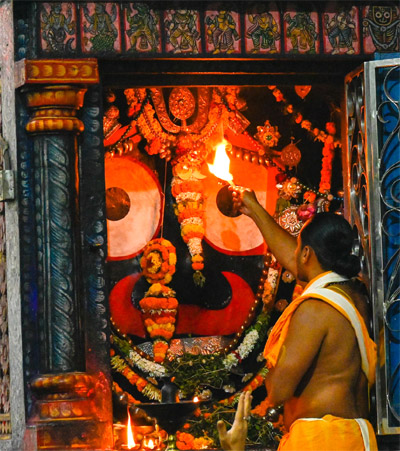
Welcome to Purusottama Kshetra, the sacred realm where the Lord of the Universe resides.
If you dive deep into the ancient verses of the Skanda Purana (specifically the Utkala Khanda), you will encounter a profound truth: Mahaaprabhu Shree Jagannatha does not live in Puri merely as a distant, abstract deity. He lives there as a human being, an Emperor, and a living member of the Odia household.
The daily rituals—known locally as Nitis—mirror the everyday life of a human being. From waking up in the early hours to brushing His teeth, bathing, eating multiple hearty meals, changing clothes according to the days of the week, and finally going to sleep, the Lord’s routine is full of baatsalya bhaba (filial devotion).
Let us walk through a complete day in the grand temple of Puri, exploring the intricate Dainika Nitis (daily rituals) from dawn to midnight.
1. The Awakening: Dwaara-phitaa & Mangala Aalati (04:30 AM – 05:30 AM)
The day begins before the sun rises. Five specific Sevaayatas (servitors) gather outside the heavy wooden doors of the Garbhagruha (sanctum sanctorum).
Dwaara-phitaa (Opening of the Doors): The Taluchha Mahaapatra verifies that the wax fabric seal placed the previous night is perfectly intact. Once verified, the seal is broken, and the Pratihaari servitors throw open the doors to the sound of blowing conch shells (Sankha), beating cymbals, and early morning Kirtana.
Mangala Aalati: The very first Darshana of the day. The Bhitarachha Mahaapatra performs the Aalati for Lord Jagannatha, while two Pushpaalaka servitors perform it for Lord Balabhadra and Devi Subhadra. They use Karpura (camphor), Bati (wick), and Pithau (flour) lamps to dispel the darkness.
2. Morning Ablutions: Mailama & Abakaasha (06:00 AM – 06:45 AM)
Just as we change out of our nightclothes and freshen up, the Deities undergo a detailed morning cleansing routine.
Mailama: This term translates to the removal or changing of clothes and flowers. The night clothes and withered flowers from the previous evening are removed. The Deities are then dressed in light cotton garments called Tadapa and Uttariya.
Abakaasha Niti: This is the formal morning bath and dental hygiene ritual. Because the wooden statues cannot be directly drenched in water daily, this ritual is performed using Darpana (pure brass mirrors) placed in front of each Deity. The reflections of the Deities are symbolically brushed using tooth sticks, tongue-scrapers, and washed by splashing water mixed with Amla (gooseberry paste), Chandana (sandalwood), camphor, and curd. During this time, the Jyotisha (temple astrologer) stands nearby and reads out the Tithi (astrological calendar alignment) for the day.
3. Dressing in the Day’s Colors: Besha Lagi (06:45 AM – 08:00 AM)
After their bath, the Deities undergo another Mailama to shed their wet Tadapa clothes. They are then adorned in glorious silk garments (Paatta clothes) and exquisite floral ornaments like Guna, Jhumpa, and Adhara-maala.
As Indresh Upadhyay often emphasizes in his kathas, the color of the Lord's attire matches the cosmic planetary rulers of each specific day of the week:
Ravibaara (Sunday): Red (Lala)
Somabaara (Monday): White or spotted black and white (Dhabala / Kala-Kendra)
Mangalabaara (Tuesday): Five-colored stripe (Baara-paattia)
Budhabaara (Wednesday): Blue (Nila)
Gurubaara (Thursday): Yellow (Haladia)
Sukrabaara (Friday): Pure White (Sukla)
Sanibaara (Saturday): Black (Kala)
Following this, Sahanamela occurs, a designated hour where common devotees are allowed close access to the Ratnavedi (the sacred golden platform) to view the Lord from arm's length without any fee.
4. The Feast Begins: Gopala Ballabha & Sakala Dhupa (08:30 AM – 10:00 AM)
No discussion of Jagannatha Sanskriti is complete without Bhoga (food offerings).
The Sacred Kitchen Rule: Before any cooking begins for the day, a special Rosha Homa (fire sacrifice) is conducted in the Rosa-ghara (the largest temple kitchen in the world) to sanctify the hearths. Concurrently, Surya Puja (Sun worship) and Dwaara-paala Puja (worship of the guardian deities Jaya and Vijaya) are carried out.
Gopala Ballabha Bhoga: The Lord's early morning light breakfast. It consists of simple, comforting items: Khai (sweet popped rice), Khua-laadu (condensed milk sweets), Kora (coconut candies), fresh curd, chipped coconuts, and ripe bananas. It ends with the offering of Pana (aromatic betel leaf).
Sakala Dhupa (Raja Bhoga): The first heavy morning meal. Three Puja Panda servitors sit on the Ratnavedi to perform a Shodasha-upachaara Puja (worship using 16 ritual items). The meal includes traditional Odia delicacies cooked exclusively in earthen pots: Khechudi (lentil rice ghee-mash), Kanika (sweet flavored rice), various types of green leafy vegetables (Saga), and traditional steamed cakes like Kanti and Enduri Pitha.
5. Midday Royalty: Bhoga Mandapa & Madhyaanha Dhupa (11:00 AM – 01:00 PM)
Bhoga Mandapa Bhoga: Unlike the intimate offerings made inside the inner sanctum, a massive quantity of food is brought into the Bhoga Mandapa hall. This offering is dedicated to the public and satisfies the thousands of pilgrims waiting for Mahaaprasada.
Madhyaanha Dhupa: The grand midday lunch offering. The ritual structure mirrors the Sakala Dhupa, offering heavy traditional courses of seasoned rices, rich dals, and slow-cooked indigenous vegetable curries (completely devoid of foreign elements like potatoes, tomatoes, or green chilies).
6. The Afternoon Nap: Madhyaanha Pahuda (01:30 PM – 02:00 PM)
Human nature dictates a short rest after a heavy lunch, and the Lord follows the same rhythm. The Khata Seja (wooden bedsteads) are laid out, the doors are locked, and the Deities enjoy their midday siesta, known as Madhyaanha Pahuda.
7. Evening Elegance: Sandhyaa Aalati & Sandhyaa Dhupa (06:00 PM – 08:00 PM)
As twilight falls over the Bay of Bengal, the temple springs back into dynamic action.
Sandhyaa Aalati: The doors reopen, and bright oil lamps are waved before the dark-eyed Lord to mark the transition to evening.
Sandhyaa Dhupa: The evening dinner offering. The quantity of food is lighter than the daytime meals. It prominently features Pakhala (watered rice) along with traditional baked or fried flour cakes (Pitha).
Chandana Lagi: After dinner, the Deities are lovingly massaged with a cooling paste of Chandana (sandalwood) mixed with Karpura (camphor), Keshara (saffron), and Kasturi (musk) to soothe them after a long day.
8. The Final Splendor: Bada-singhaara Besha & Dhupa (09:00 PM – 11:00 PM)
This is visually and emotionally considered the most beautiful Niti of the entire day.
Bada-singhaara Besha: The night adornment. The Deities change out of their day dresses into specialized silken garments called Baralaagi Paatta. Woven cleanly into the fabric of these silk clothes are the holy verses of the Gita Govinda, written by the legendary Odia poet Jayadeva. The Deities are heavily decorated with massive, intricate flower garlands, floral headgears (Hrudaya Padaka), and matching dynamic floral crowns.
Bada-singhaara Dhupa: The final late-night culinary offering. The Deities are served light, soothing items like Kanji (fermented rice gruel), sweet gruels, and delicate coconut treats.
9. Retiring to Bed: Pahuda Niti (11:30 PM – Midnight)
The final chapter of the day ensures the cosmic caretakers go to rest.
The Khata Seja Lagi takes place, where luxurious beds are formally prepared inside the sanctum. The movable metal idol of Sayana Thaakura (representing the sleeping form of Lord Vishnu) is brought from the temple treasury (Bhandara-ghara) and placed lovingly next to Lord Jagannatha.
Green coconut water (Paida Pani) and fragrant Pana are placed as a nightstand offering. As the Devadasi (historically) or the Sevaayatas sing gentle, melodious stanzas of the Gita Govinda accompanied by a soft veena, a final Karpura Aalati is shown.
The servitors back out slowly. The heavy doors are locked, and the Taluchha Mahaapatra places the fabric-wax seal over the latch once again. The cosmos falls into silence as Mahaaprabhu drifts into slumber, only to wake up again tomorrow to love His devotees all over again.